
Compositional Works
In addition to his operatic career, Stefan is an aspiring composer whose creative output is deeply informed by his life on the stage, and blending his Nordic heritage with contemporary American sensibilities. Specializing in vocal and orchestral music, he bridges the gap between performer and creator. His portfolio includes original art song settings, orchestral and choral works, and a one-act opera. As a graduate student in vocal performance at the Shepherd School of Music at Rice University, Stefan draws directly on his training in vocal technique and dramatic storytelling. His compositional style pairs the expansive colors of the piano or orchestra with a natural affinity for the human voice, focusing on lyrical, text-driven works that are both expressive and rewarding to perform.

New Recording
As I Ebb'd with the Ocean of Life
Written for soprano and piano, the four-movement song cycle As I Ebb’d with the Ocean of Life offers a rigorous, text-driven exploration of the psychological and existential anxieties in Walt Whitman’s Leaves of Grass. The work translates the speaker's confrontation with mortality into a musical expression in which thematic development and text-setting are linked. In the opening movement, the piano’s undulating eighth-note figurations establish a persistent ocean motif, which then fractures into stark triplet ostinatos to evoke imagery of instability. The second movement employs a more radical text-to-music translation; to embody the concept of "wash'd up drift," the score introduces an unmetered, aleotoric 16th-note texture that strips the keyboard of traditional harmonic direction. Following the urgent, rhapsodic development of the third movement, the finale provides structural closure through acute word-painting, and the return of several themes. It begins with pointillistic, high-register notes that mimic the literal dripping of water, undergoes volatile tempo fluctuations to track the text's shifting emotional density, and ultimately resolves its final climax into a suspended, unmeasured gesture marked "like starlight," leaving the work satisfyingly unresolved.
Invitation to Love
Composer’s Note: "Invitation to Love" grew out of conversations about the vulnerability of new romance, leading me to the text of Paul Laurence Dunbar. As the first African American poet to achieve national acclaim, Dunbar’s 1896 poem personifies love as an eagerly awaited guest.
Struck by the text's inherent musicality, I set the stanzas strophically to mirror his specific rhyme schemes. As the "invitation" repeats, the music shifts into a sporadic ostinato, capturing the unpredictable emotions of budding romance. Written for and premiered by baritone Jack Burrows and pianist Rachel Chao, this setting aims to balance the poem's delicate hope with its nuanced emotional color.
Jack Burrows, baritone. Rachel Chao, piano. In recital, 4/24/26

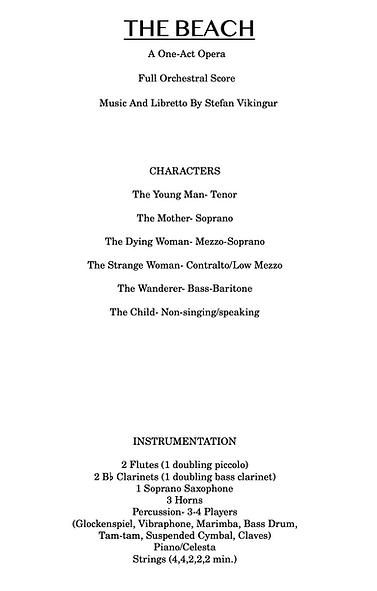
The Beach | A One-Act Opera
Written for an ensemble cast of six characters and a large chamber orchestra, The Beach explores grief and memory through a non-linear narrative, thrusting its characters into a threshold that exists outside of time and space.
Synopsis
There is a place where memory and reality blur, where time dissolves, and where Life and Death meet. It is neither heaven nor hell, but a doorway, a place of searching, of longing, and of unfinished stories.
Here, the doorway reveals itself as a beach, a shore between worlds.
Onto this shore comes a Young Man, pulled from the water with no memory of who he is or why he has arrived. He encounters the Wanderer and the Strange Woman, mysterious figures who seem to guide but never fully explain. A grieving Mother wanders the sand, with only memories of her lost child, while a Dying Woman grasps at a hand holding hers, and the dwindling warmth of life.
As the tide brings fragments of the past to the surface, a flower, a toy, a scarf, and something far more sinister, the visitors begin to recognize each other not as strangers but as reflections of themselves. Their stories unfold in fragments, though the truth of their connection remains hidden. A Young Man, lonely and lost, a mother consumed with grief, a woman suspended between death and life. Only when The Beach allows, will they see how inseparably their fates are woven.
The Beach grants no clear answers, only a choice. Remain suspended in the endless in-between, journey onward into the unknown, or return to the harshness of life, to its pain, its impermanence, and its fleeting, radiant beauty.
Oh How Beautiful The Stars
Written for and dedicated to Desert Voices, Tucson’s premier LGBTQIA+ community chorus, Oh How Beautiful The Stars was composed specifically for PRISM, the ensemble’s small, advanced chamber group. This lyric SATB setting serves as an intimate, text-driven meditation on vulnerability, peace, and human connection.
Beginning with a gentle piano introduction, the piece opens with a warm, layered homophonic texture as the voices invite the listener to "lay your head on the soft green grass". The music captures a pastoral tranquility, pairing lush choral harmonies with thoughtful breathing spaces. As the text pivots to an expansive cosmic perspective at the "Meno mosso," the texture shifts dynamically. Rich, building vocal lines emerge into fortissimo peaks to mirror the emotional warmth of the stars, before returning to a moving, reflective "A tempo" motif. Written during my time as Assistant Artistic Director, this piece balances delicate vocal lyricism with a soaring, supportive accompaniment, offering a shared space of comfort and wonder under the night sky.